
Contents:
- The Difference Between “Thin” and “Fine” Hair, and Why It Matters Here
- Why These Methods Specifically Make the List
- Nano Bond Hair Extensions
- Fine Micro Bonds
- Curl or Texture-Matched Tape-Ins
- Seamless Clip-In Wefts
- Lightweight I-Tip Extensions
- Comparison Table
- What Makes a Bond Truly Invisible, Beyond Size Alone
- A Regional Note
- A Real Example
- Styling Choices That Help or Hurt Invisibility
- How to Choose the Right Invisible Method
- Maintaining Invisibility Over the Full Refit Cycle
- FAQ
- Are nano bonds really invisible, or just less visible?
- Do nano bonds hold as much hair as classic bonds?
- Is nano bonding suitable for very thin, damaged hair?
- How much more does nano bonding cost compared to classic bonds?
- Can thin hair support extensions long-term without thinning further?
What actually makes an extension “invisible” — is it the bond size, the hair colour match, or something else entirely? That question sits at the centre of every search for hair extension beauty salon options among people with thin hair, who care less about volume for its own sake and more about not being able to spot the join. Here are the five most genuinely invisible methods available in the UK in 2026, ranked specifically for thin and fine hair rather than average density.
The Difference Between “Thin” and “Fine” Hair, and Why It Matters Here
These two terms get used interchangeably, but they describe different things and can call for different methods. Thin hair refers to the number of hair strands per square centimetre of scalp — low density overall. Fine hair refers to the diameter of each individual strand, regardless of how many there are. Someone can have thin but coarse hair, or dense but very fine hair, and the ideal invisible method differs in each case. Genuinely thin hair benefits most from smaller, more numerous bonds spreading the load; genuinely fine hair benefits from lighter overall extension weight, regardless of bond count. A consultation that asks about both separately, rather than treating “thin hair” as one single category, gives a far more accurate recommendation.
Why These Methods Specifically Make the List
Thin hair has less natural bulk to disguise an attachment point, which means bond size and sectioning precision matter far more than they do for thicker hair types. The methods ranked here were chosen specifically because they minimise visible bulk at the root rather than simply being popular extension methods in general.
1. Nano Bond Hair Extensions
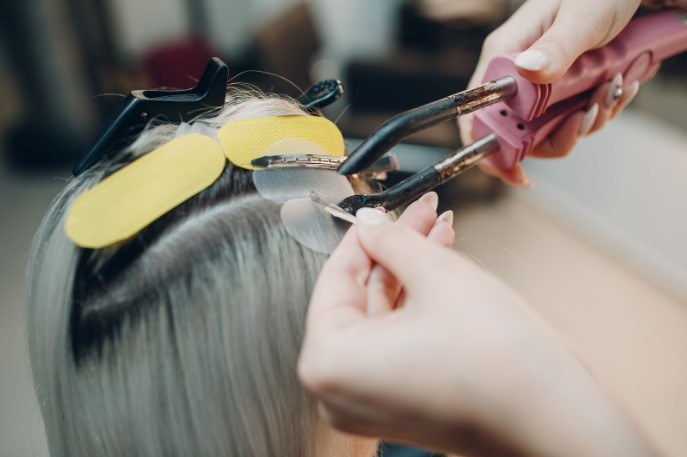
Nano bonds use the smallest attachment point available on the market, a fine metal ring or micro keratin tip barely larger than the natural hair strand itself. For thin hair specifically, this is the closest thing to a genuinely undetectable bond, since there’s so little bulk added at the root that even a close parting rarely reveals it. Booking nano bond hair extensions requires a more time-intensive application — often 4 to 5 hours for a full head — because more, smaller bonds are needed to reach the same volume a classic bond would achieve in fewer attachment points. That extra time is precisely the trade-off that makes nano bonds worth it for anyone whose main priority is invisibility over speed.
2. Fine Micro Bonds
A step up in size from nano but still meaningfully smaller than classic bonds, fine micro bonds strike a balance between application speed and discretion. They suit thin hair that still has reasonable density, where nano bonds might be overkill but classic bonds would create visible bulk.
3. Curl or Texture-Matched Tape-Ins
Tape-ins naturally lie flatter than any bonded method, which makes them a strong invisibility option for thin, straight hair specifically. The flat adhesive strip disappears against the scalp when sectioned correctly, though thin hair needs slightly narrower tape strips than the industry-standard width to avoid visible edges.
4. Seamless Clip-In Wefts
Modern seamless wefts use a thinner, more flexible weft base than older clip-in styles, distributing clip pressure across a wider area so individual clips don’t create visible bumps under thin hair. They remain the only method here requiring zero salon appointment.
5. Lightweight I-Tip Extensions
A heat-free, keratin-free alternative fed through a small link, lightweight I-tips use less extension hair per strand than standard I-tips, keeping bulk down for thin hair while still offering the natural movement of an individually bonded method.
Comparison Table
| Method | Invisibility for Thin Hair | Application Time | Comfort |
|---|---|---|---|
| Nano Bonds | Excellent | 4–5 hours | Very good |
| Fine Micro Bonds | Very good | 3–4 hours | Good |
| Texture-Matched Tape-Ins | Good | 1 hour | Good |
| Seamless Clip-Ins | Good with correct placement | None (self-applied) | Fair |
| Lightweight I-Tips | Very good | 3 hours | Good |
What Makes a Bond Truly Invisible, Beyond Size Alone
Bond size gets most of the attention, but colour matching and sectioning angle matter almost as much for genuine invisibility. A nano bond in a slightly wrong shade stands out just as much as a larger bond in the correct colour, because the eye catches contrast before it catches size. Sectioning at a slight diagonal, rather than a perfectly horizontal row, also helps bonds blend into the natural fall of thin hair rather than sitting in a detectable line. Any studio recommending nano or micro bonds without discussing colour-matching in the same conversation is only solving half of the invisibility problem.

A Regional Note
Demand for nano bonding skews noticeably toward London and the South East, where clients in fast-paced professional environments often prioritise a completely undetectable result over cost or speed. In the North and parts of Scotland, fine micro bonds see more bookings, partly reflecting availability of nano-trained technicians and partly a slightly different balance of price versus discretion that clients there tend to prefer.
A Real Example
A client with naturally thin, fine hair came to Ivana Farisei after a previous salon applied standard classic bonds that were visible every time she pulled her hair into a ponytail for the gym. Switching to nano bonds at her next refit, with the same total hair volume spread across nearly double the bond count, solved the visibility problem entirely — she reported that colleagues who’d noticed her volume increase couldn’t spot where the extensions actually attached, even up close.
Styling Choices That Help or Hurt Invisibility
The method matters, but so does how the hair is worn day to day. A middle parting exposes the root more directly than a slightly off-centre or side parting, which naturally drapes hair over attachment points. Loose waves or soft curls, rather than sleek straight styles, add texture that helps disguise bonds even further, since straight hair shows any irregularity in the strand far more clearly than hair with some natural movement. None of this replaces choosing the right bond size, but it does mean two people with identical extensions can end up with noticeably different levels of visible discretion purely based on how they style their hair day to day.
How to Choose the Right Invisible Method
Start by being honest about your hair’s actual density, not just its length. Very thin, low-density hair benefits most from nano bonds or lightweight I-tips, where bulk reduction matters more than speed. Moderately thin hair with reasonable density can usually handle fine micro bonds without issue. Anyone wanting a zero-commitment trial run should start with seamless clip-ins before considering a semi-permanent method at all.
Maintaining Invisibility Over the Full Refit Cycle
An invisible application on day one doesn’t automatically stay that way for three or four months. As thin hair grows, even the smallest bonds shift position slightly, and without a mid-cycle check, small colour differences between new natural growth and older, sun-lightened extension hair can become noticeable. Booking a quick check-in appointment around the six-to-eight-week mark, well before the full refit, catches this early and keeps the invisibility that made the initial method choice worthwhile in the first place.
FAQ
Are nano bonds really invisible, or just less visible?
They’re the closest method to true invisibility on thin hair, though a very close inspection under bright light can still occasionally reveal a bond — the difference from classic bonds is significant, not absolute.
Do nano bonds hold as much hair as classic bonds?
No — each nano bond holds less extension hair, which is why more bonds are needed to reach comparable volume, extending application time.
Is nano bonding suitable for very thin, damaged hair?
Often yes, since the reduced weight per bond is gentler on fragile strands, though a proper consultation should confirm hair is healthy enough for any bonding method.
How much more does nano bonding cost compared to classic bonds?
Typically £50 to £150 more per full-head application, reflecting the additional technician time required.
Can thin hair support extensions long-term without thinning further?

Yes, provided the correct bond size and weight are used and refits are kept on schedule rather than left to grow out too far.
Invisibility for thin hair isn’t about finding a trendy method — it’s about matching bond size precisely to how much natural hair bulk is actually available to hide it. Getting that match right is what separates extensions nobody notices from extensions everybody does.